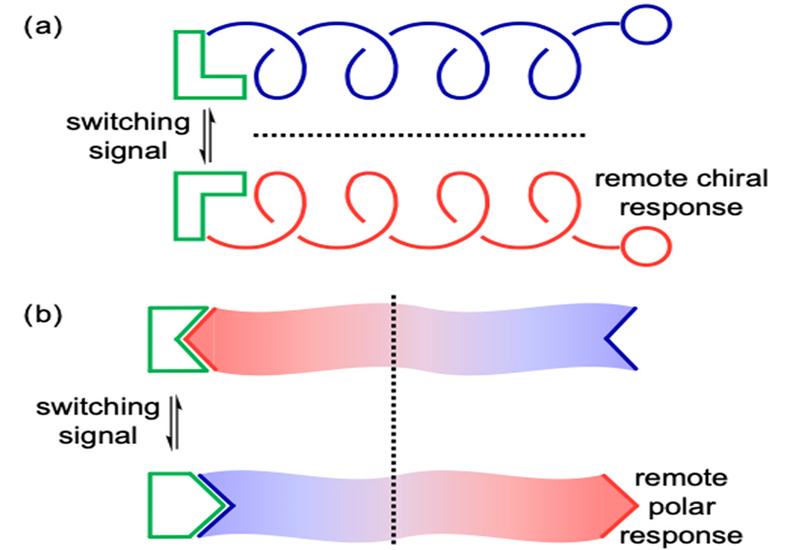
Living cells transmit information across membranes by exploiting conformational changes in proteins, yet replicating that principle with fully synthetic molecules remains a central challenge in chemical biology. Researchers working on dynamic foldamers have shown that the directionality of an intramolecular hydrogen-bond network can be reversed by external stimuli, turning these molecules into potential molecular communication devices. Ethylene-bridged oligourea and oligothiourea scaffolds are particularly attractive because they are achiral and rely on hydrogen-bond polarity rather than helical chirality, giving them conceptual compatibility with homochiral biological environments. Until now, however, detailed conformational data on these thiourea systems in membrane-like surroundings had not been reported, leaving open the question of whether their switching behavior survives the transition from organic solvent to lipid assemblies.
Researchers in the Clayden Group at the University of Bristol, published in the Journal of the American Chemical Society, synthesized a homologous series of ethylene-bridged oligothiourea foldamers containing between one and five thiourea units, each capped with para-fluorobenzyl groups to serve as 19F NMR reporters. The para-fluorobenzyl cap was selected after a comparative study of ortho-fluoro, meta-fluoro, and para-trifluoromethyl alternatives, with the para-fluorine probe offering the best balance of chemical-shift sensitivity and freedom from competing intramolecular contacts. The team used variable-temperature 1H and 19F NMR, together with ROESY and heteronuclear correlation experiments, to map hydrogen-bond directionality in deuterated chloroform and dichloromethane, and then extended the technique to two membrane-mimetic colloidal systems: sodium dodecyl sulfate, SDS, micelles and DLPC:DHPC bicelles.
In solution, the 19F probes cleanly distinguished the N-terminal fluorine environment, downfield at approximately −116.4 ppm, from the C-terminal environment at approximately −117.9 ppm in trimer 3, reporting the polarity of the coherent hydrogen-bond chain. Trimer 3 populates only the two degenerate fully coherent conformers, remaining in slow exchange above 273 K in both CDCl3 and CD2Cl2. The situation grows more complex with length. Tetramer 4 displays five distinct 19F signals at 298 K, attributed to the two globally coherent conformers 4a and 4a′, a symmetric broken conformer 4c in which both fluorines are equivalent, and two partially broken intermediates 4b and 4b′ arising from stepwise thiourea C−N rotations. Molecular mechanics calculations supported this assignment: among the fifty lowest-energy computed structures, conformers consistent with the coherent and broken forms were found, while conformers with outward-oriented C=S groups were absent even from the one hundred lowest-energy set.
When the foldamers were incorporated into SDS micelles and DLPC:DHPC bicelles, 19F NMR confirmed retention of intact hydrogen-bond networks. The chemical-shift separation between the N- and C-terminal fluorine probes narrows progressively across environments: 1.8 ppm for trimer 3 in CDCl3, 0.4 ppm in micelles, and 0.1 ppm in bicelles, reflecting increasingly similar terminal environments as the curvature and packing of the membrane mimic change. For tetramer 4 in bicelles, the broken conformers fall below the detection limit at 298 K, although they remain visible for pentamer 5. Lineshape analysis of the dimer 2 19F coalescence yielded free energies of activation for hydrogen-bond polarity reversal of 51.5 kJ mol−1 in CD2Cl2, 56.7 kJ mol−1 in micelles, and 55.9 kJ mol−1 in bicelles, a modest increase that the authors attribute to the lower effective polarity of the membrane-mimetic interior relative to dichloromethane.
This work establishes para-fluorobenzyl-capped oligothioureas as a platform for studying conformational switching in membrane environments and provides, according to the authors, the first quantitative dynamic NMR analysis of conformational interconversion energetics for a synthetic molecule embedded in a colloidal membrane mimic. The demonstration that hydrogen-bond directionality and step-by-step reversal intermediates can be tracked in bicelles opens a path toward designing foldamer-based signal transduction systems that function across lipid bilayers, with potential applications in synthetic cell communication and allosteric catalysis.